

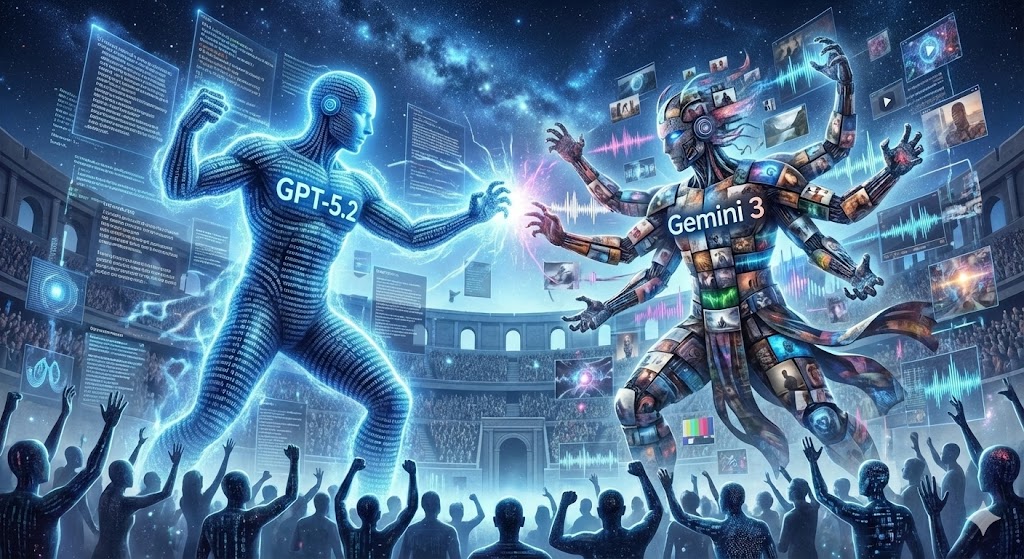
GPT vs Gemini 2026—this phrase captures the essence of an emerging rivalry poised to redefine the future of artificial intelligence. As AI technology advances rapidly, two formidable contenders—OpenAI’s GPT models and Google’s Gemini—are shaping the landscape in ways that promise transformative implications for industries, researchers, and everyday users alike. But what truly differentiates these AI systems, and how are they evolving toward 2026? This comprehensive analysis aims to unravel the core distinctions, technological advancements, and strategic visions that set GPT and Gemini apart as they compete for dominance in the AI arena.
Introduction to the Contenders
At the heart of AI development are pioneering organizations that push the boundaries of what machines can comprehend and generate. Over the years, several models have emerged, but few have garnered as much attention as GPT and Gemini. Both are rooted in groundbreaking research but diverge significantly in philosophy, architecture, and application focus. To appreciate the coming battleground in 2026, it’s essential to start with an understanding of their origins and evolutionary paths.
Overview of GPT and Its Origins
OpenAI’s Generative Pre-trained Transformer (GPT) series represents a milestone in natural language processing. The initial version, GPT-1, laid the foundation for creating models that learned language patterns in an unsupervised manner, setting new standards for coherence and contextual understanding. Building on this, GPT-2 soared in popularity thanks to its impressive ability to generate human-like text, sparking both excitement and concern over AI’s potentials and limitations.
By the time GPT-3 rolled out, the model featured 175 billion parameters, vastly expanding its capabilities and enabling diverse applications from chatbots to content creation. With its adaptable architecture, GPT has become an industry staple, powering numerous SaaS platforms and AI tools like content generators, code assistants, and customer service bots. Its open access model initially fostered innovation but also sparked debates over misuse and ethical safeguards.
Looking forward to 2026, GPT’s evolution is anticipated to involve more nuanced understanding, multimodal capabilities, and enhanced safety features—all while maintaining its core strength: natural, versatile language generation. As a key player in the AI landscape, GPT’s journey reflects a dedication to democratizing AI and making it accessible for various sectors.
Understanding Gemini and Its Development
Conversely, Google’s Gemini is the culmination of years of research focused on creating a more integrated, multimodal AI system. Unlike GPT, which primarily concerns language, Gemini aims to handle text, images, video, and even audio seamlessly—mirroring how humans process multiple sensory inputs simultaneously. This approach signals a broader vision where AI isn’t just about language but about mastering diverse forms of data in unified environments.
Gemini’s development stems from Google’s extensive investments in the DeepMind division, aiming to enhance AI’s reasoning, problem-solving, and contextual understanding. The platform emphasizes advanced training techniques, including reinforcement learning from human feedback and hybrid models that combine symbolic reasoning with neural networks.
By 2026, Gemini is projected to push the envelope further, featuring greater autonomy in decision-making, real-time multimodal interactions, and domain-specific expertise. Its development roadmap demonstrates a focus on creating AI that’s not just reactive but proactively intelligent—anticipating user needs and collaborating across data types to produce more comprehensive responses and solutions.
The Rise of AI Competition Leading to 2026
The quest for AI supremacy is fueling intense research and development efforts among tech giants and startups. What’s unique about 2026 is not just the arrival of these powerful models but their integration into everyday workflows, robotics, healthcare, finance, and entertainment. The competition reflects broader trends: decentralization of AI innovation, democratization of tools, and growing concerns over safety and ethical implications.
Both GPT and Gemini are setting benchmarks in efficiency, safety, and scalability. As their capabilities expand, so do their potential applications—ranging from autonomous vehicles to sophisticated virtual assistants. This race also influences hardware innovation, with the need for higher processing power and optimized AI chips, which are crucial in enabling real-time, multimodal AI solutions.
Furthermore, the competitive landscape accelerates the adoption of AI safety standards and ethical frameworks. As both models face challenges regarding bias, transparency, and accountability, their development trajectories are shaped by societal and regulatory pressures. The evolution toward 2026 thus encapsulates a broader societal dialogue about the responsible deployment of AI technologies.
Key Differences in Their Core Philosophies
While GPT centers on the philosophy of language modeling, emphasizing large-scale pretraining and adaptability, Gemini promotes integrated multimodal reasoning, aiming for AI that can think and act across multiple data types. This philosophical divergence influences not only technical design but also strategic goals.
GPT values the scalability of textual understanding. Its architecture is optimized for composing, summarizing, translating, and engaging in fluent dialogue. By contrast, Gemini aspires to simulate human-like perception—recognizing a scene in a video, understanding a vocal tone, and integrating these inputs to produce contextually relevant outputs.
These differing philosophies impact their development focus: GPT seeks to excel in language-centric applications, often enabling content creation and communication tools; Gemini strives to build comprehensive, adaptive AI systems that seamlessly combine sensory data. As they approach 2026, these core visions will define their roles, strengths, and limitations in shaping our AI-dependent society.
Evolution and Technological Advancements
The trajectory from initial prototypes to full-fledged 2026 models reflects rapid advancements in architectures, training methodologies, and our understanding of AI’s capabilities. Both GPT and Gemini are products of iterative research, with each new version bringing renewed focus on efficiency, safety, and versatility. Understanding these advancements is crucial for grasping how these systems might perform in their future iterations.
GPT’s Journey from Inception to 2026 Projections
GPT started as a proof of concept—demonstrating that transformer models could generate coherent, contextually rich text—and has since undergone numerous refinements. The leap from GPT-2 to GPT-3 was marked by an exponential increase in parameters, significantly boosting language understanding and generation capabilities. The transition from static models to zero-shot and few-shot learning paradigms allowed GPT to perform tasks with minimal training data, broadening its scope.
Projected developments towards 2026 suggest that GPT will incorporate larger datasets, more sophisticated fine-tuning, and enhanced safety layers. The integration of reinforcement learning from human feedback (RLHF) will likely be more refined, improving contextual appropriateness and reducing biases. Additionally, GPT’s multimodal capabilities might be expanded—integrating images and audio—to support a wider array of applications.
The technological roadmap points toward increased efficiency—reducing model size without sacrificing performance—through innovations like model pruning and advanced hardware utilization. Moreover, new architectures may focus on interpretability, allowing users and developers to better understand AI reasoning, fostering trust, and facilitating compliance with emerging AI regulations.
Gemini’s Innovations and Roadmap to 2026
Gemini’s development emphasizes creating a holistic AI that perceives and understands multiple data modalities simultaneously. Initially, Gemini’s focus was on integrating vision and language, but subsequent versions aim to incorporate audio, video, and possibly tactile data. This multimodal convergence aligns with challenges faced in robotics, autonomous vehicles, and smart environments.
Researchers at Google and DeepMind are experimenting with innovative training approaches—such as hybrid models that blend deep learning with symbolic reasoning—to enhance contextual understanding and logical consistency. Reinforcement learning techniques will likely play a prominent role, enabling Gemini to adapt its responses based on environmental feedback, much like humans learn from experience.
Looking ahead, Gemini’s roadmap involves scaling its models to handle high-dimensional data efficiently while maintaining interpretability. Real-time processing is a key focus, especially for deployment in dynamic environments like autonomous vehicles or interactive AI companions. Moreover, safeguard mechanisms centered on explainability and bias mitigation are expected to be integral to the architecture by 2026, ensuring responsible AI behavior.
Comparative Timeline of Major Updates
The evolution of both models highlights the acceleration of AI capabilities. GPT’s significant milestones—like GPT-2’s release in 2019, GPT-3 in 2020, and iterative safety and multimodal enhancements—have set industry standards. Conversely, Gemini’s milestones include multimodal integration experiments and domain-specific adaptations, showcasing a focus on seamless sensory fusion.
As the timeline converges toward 2026, both models are likely to exhibit unprecedented scalability, robustness, and contextual comprehension. The key difference remains in their emphasis: GPT on language understanding and generative power, Gemini on sensory integration and reasoning—both critical for future AI applications across sectors.
Core Features and Capabilities
The true test of these AI systems lies in their core features and how they perform across real-world scenarios. As AI progresses towards 2026, features such as multimodal processing, scalability, security, and ethical considerations become even more critical. A comparative understanding of these aspects sheds light on their potential roles and limitations.
Language Processing and Natural Interaction
GPT’s hallmark is its remarkable proficiency in natural language processing. Its ability to generate human-like text, engage in dialogues, and handle complex contextual interactions makes it invaluable for chatbots, virtual assistants, and content creation tools. It excels in understanding nuance, tone, and intent, providing responses that often feel intuitive.
In comparison, Gemini aims to transcend language by integrating additional data modalities—vision, sound, and even haptic information—to enrich interaction. Future iterations may enable AI to interpret not just what is spoken or written but also the environment’s visual and auditory cues, leading to more natural, multi-sensory exchanges. This multimodal interaction could redefine human-AI engagement, especially in professional settings like telemedicine, education, and customer service.
While GPT remains unparalleled in textual fluency, Gemini’s multimodal approach promises more comprehensive and context-aware interactions, broadening AI’s applicability in complex real-world environments. Consequently, both models will likely complement each other—GPT excelling in language-centric tasks and Gemini providing holistic, sensory-rich experiences.
Multimodal Functionality and Integration
Multimodal AI is increasingly viewed as the future, enabling systems to interpret and respond to multiple data types simultaneously. GPT’s existing models are expanding into this domain through integrations with visual and audio modules, but Gemini’s architecture is inherently designed for such integration.
By 2026, Gemini’s multimodal capabilities are expected to be highly advanced, enabling applications such as autonomous vehicles that interpret visual scenes while understanding verbal commands or robots that see, hear, and respond in real time. This integration allows for more intuitive and contextually relevant responses, especially in environments where language alone is insufficient.
GPT is evolving to incorporate multimodal features as well, but its strength remains rooted in text-based applications. Both models will likely focus on scalability in processing high-dimensional data, ensuring that multimodal AI systems are efficient, reliable, and safe across diverse use cases. The synergy between these models could lead to hybrid systems where language generation and multimodal perception work seamlessly.
Scalability and Efficiency in Real-World Use
Scalability determines how well an AI model can handle increasing data loads, user demands, and diverse applications without performance degradation. GPT’s scalable architecture has already demonstrated this through its adaptation in numerous SaaS products. Future improvements aim to optimize computational efficiency via techniques like model pruning, quantization, and specialized hardware.
Gemini’s challenges include managing high-dimensional multimodal data efficiently—requiring innovations in model design, hardware acceleration, and training algorithms. Its roadmap emphasizes deploying lightweight, energy-efficient models suitable for real-time applications across devices and environments. This is crucial for sectors like healthcare, where latency and accuracy are vital.
The balance between scalability, efficiency, and safety is critical. Both models’ future success hinges on deploying AI that is not only powerful but also accessible and sustainable. Advances in hardware, such as AI-specific chips, and software optimizations will play vital roles in supporting these goals.
Security and Ethical AI Implementations
As AI systems become more embedded in our lives, ensuring safety, security, and ethical integrity becomes paramount. GPT models have incorporated safety layers and bias mitigation techniques, but ongoing challenges remain with misinformation, bias, and transparency.
Gemini’s multimodal nature introduces additional complexities, requiring safeguards across multiple data channels. Its development emphasizes explainability, bias detection, and user control to foster trust. Techniques like Reinforcement Learning from Human Feedback (RLHF) will likely be more sophisticated, aiming to make AI responses more aligned with societal norms.
Industry adoption of responsible AI frameworks and standards will influence both models. Hybrid approaches—combining the strengths of GPT’s language models with Gemini’s multimodal reasoning—may include embedded compliance features, data privacy protections, and explainability modules to ensure safe, ethical AI evolution leading up to and beyond 2026.
Performance and Benchmark Analysis
Assessing future AI models involves understanding their performance benchmarks, especially regarding speed, accuracy, and ability to handle complex tasks. Over the next few years, both GPT and Gemini are expected to meet and surpass benchmarks that currently serve as industry standards.
Speed and Accuracy Metrics in 2026 Scenarios
Current language models like GPT-3 already demonstrate impressive speed, but their computational demands are high. Optimizations such as model compression and hardware acceleration are critical to achieving real-time responsiveness in practical scenarios.
By 2026, GPT models are expected to incorporate next-generation hardware such as tensor processing units (TPUs) and AI chips optimized for large-scale transformers, significantly reducing latency. Accuracy will also improve with larger training datasets, fine-tuning, and advancements in model architecture, enabling more precise and contextually appropriate responses even in nuanced conversations.
Gemini’s multimodal complexity presents a different challenge—integrating multiple data pipelines efficiently. Advances in hardware acceleration and hybrid training techniques will enhance its processing speed, allowing for real-time applications that interpret complex visual and auditory inputs quickly and accurately.
Handling Complex Tasks and Edge Cases
AI’s ability to manage complex, unpredictable situations—such as ambiguous language or unforeseen environmental variables—is vital for practical deployment. GPT’s strength lies in language understanding, but its limitations include susceptibility to biases and occasionally generating less relevant outputs in edge cases.
Gemini’s multimodal reasoning is designed to mitigate such limitations by integrating multiple cues, offering better contextual awareness. Its architecture aims to handle intricate tasks like interpreting a video scene in conjunction with spoken instructions or environmental data, thereby reducing error rates in complex scenarios.
Both models will likely arrive at new benchmarks for safety and robustness, incorporating adaptive learning techniques to improve performance continuously. Their success in managing edge cases will determine their suitability for critical applications like healthcare diagnostics, autonomous navigation, and high-stakes decision-making.
Conclusion
As we look toward 2026, the AI battleground between GPT and Gemini reflects a broader quest for more intelligent, versatile, and safe artificial systems. GPT continues to dominate in language-centric applications, emphasizing scalability and coherence, while Gemini’s design prioritizes multimodal perception and reasoning across multiple data streams. Both models are evolving rapidly, driven by breakthroughs in training techniques, hardware integration, and ethical safeguards—all aimed at creating AI that is powerful, responsible, and aligned with human needs. The future landscape will likely feature a spectrum of hybrid systems, drawing on each model’s strengths, ultimately shaping a world where AI enhances every facet of life in ways we are only beginning to imagine.
This article aims to offer a detailed, thoughtful perspective on the ongoing competition and evolution of AI models like GPT and Gemini, providing insights into what anticipates in 2026 and beyond.
Leave a Comment
Your email address will not be published.