Dead Signal Book Builder Review: Is the $17 Claude Skill Worth It? (+ Bonus Vault)
Dead Signal Book Builder review: what the $17 Claude Skill does, how its 11-stage horror workflow works, who it suits and how to claim our Bonus Vault.
Get Dead Signal + Bonus Vault Includes our free Bonus Vault after purchaseAffiliate link · Disclosure
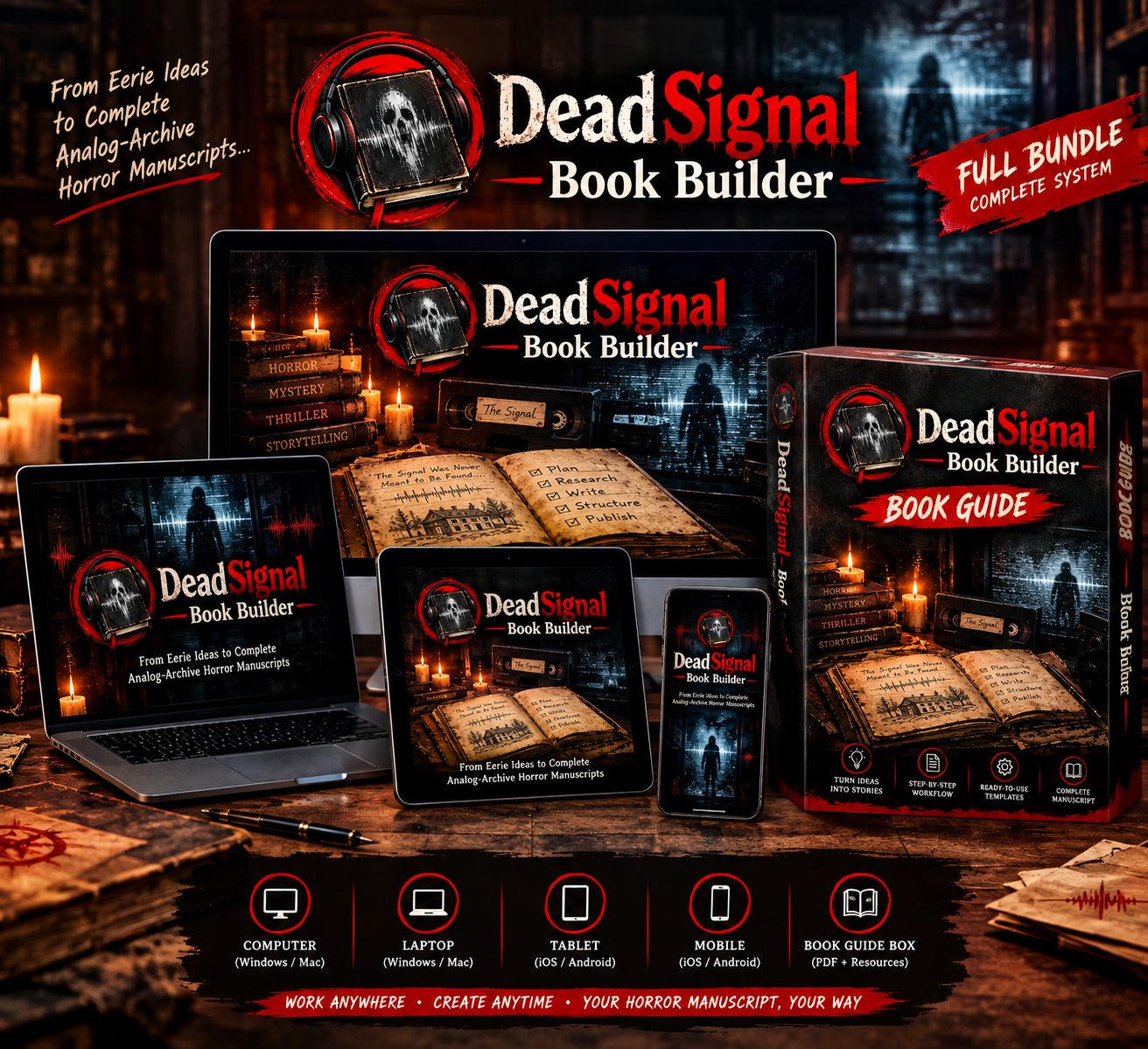
If you have a folder full of unsettling premises but no finished manuscript, Dead Signal Book Builder is aimed at the gap between the idea and the first draft.
The product is presented as a guided AI skill for Claude, built around analog horror and archive horror. It is a writing framework rather than a one-click novel generator. That distinction matters: the system can organise decisions and keep a project moving, but you still supply the taste, voice and final editorial judgment.
The front-end is advertised at $17 as a one-time purchase. Our Bonus Vault adds a story-bible worksheet, reveal ladder and 30 scene starters after purchase.
What Dead Signal Book Builder is supposed to do
The advertised workflow takes a rough premise through a sequence of planning stages: a horror hook, threat and entity rules, a story bible, a reveal ladder, chapter architecture, scene drafting and a continuity review. In plain language, it is intended to keep the scary idea coherent after the opening paragraph.
That focus is useful for analog horror because the format depends on controlled information. The reader needs to understand just enough of the signal, archive or entity to keep asking questions, while the author needs a private record of what the story has already established.
The 11-stage workflow, in practical terms
The official offer describes a staged process rather than one giant “write my book” prompt. The exact labels may change with the product, but the working sequence is designed to move from premise to a continuity-checked draft.
- Concept brief and hookTurn the spark into a premise with a specific fear mechanism.
- Characters and threat rulesDefine the lead, supporting cast, entity, costs and limits.
- Setting and archive logicDecide how the evidence exists and why it can be trusted.
- Story bibleKeep canon, clues, locations and open questions together.
- Reveal ladderControl what the reader learns and when.
- Act and sequence mapGive the middle a shape before drafting scenes.
- Chapter cardsAssign each chapter a goal, turn, cost and hook.
- Scene draftingDraft from the card while preserving point of view and tension.
- Evidence and artifact passMake recordings, transcripts or documents feel internally consistent.
- Canon trackerCheck names, rules, timeline and clue placement.
- Adversarial reviewChallenge the outline before the manuscript reaches readers.
Why the stage structure matters
The opening stage is designed to turn a one-line idea into a premise with a specific source of unease. For an abandoned broadcast, for example, that might mean deciding what the signal can do, what it cannot do and why a character keeps listening.
Design the threat before drafting scenes
Horror weakens when the threat changes rules whenever the plot needs a rescue. The advertised entity architecture is meant to define limits, triggers, costs and escalation early, giving later scenes something to obey.

Keep the story bible and reveal ladder in one place
The story bible is the practical centre of the system: characters, locations, rules, clues and unresolved questions can be tracked before they are scattered across separate chats. A reveal ladder then gives the writer a way to pace what the audience learns across the book.
Move from chapter architecture to scenes
Many writing tools are good at producing a paragraph and poor at sustaining a book. The chapter stage is intended to bridge that gap with point of view, conflict, escalation and scene objectives before prose is drafted.
Run an adversarial continuity pass
The final advertised layer looks for plot holes, contradictions and broken canon. Treat this as a second pair of eyes, not a guarantee. AI can miss a subtle contradiction, and it can also flag an intentional ambiguity as an error.
A worked example: one premise through the framework
To show how the stages fit together, here is a short walk-through of a single idea — a night-shift radio operator who keeps receiving a broadcast from a station that was demolished years ago.
- Hook and fear mechanismThe signal only transmits between 3:14 and 3:33 a.m., and each broadcast describes something in the operator's room before it happens.
- Threat rulesThe entity cannot act while the operator stays off-air; it gains one "reply" every time they key the microphone. That cost is fixed, so later scenes cannot cheat it.
- Archive logicThe story is assembled from shift logs, tape timestamps and a maintenance ticket, which sets why the evidence survives and who could have tampered with it.
- Reveal ladderRung 1: the station was demolished. Rung 2: the voice knows the operator's name. Rung 3: the previous operator filed the same logs, word for word, in 1998.
- Chapter card + sceneChapter 4's card: goal — confirm the 1998 logs; turn — the operator hears their own voice on the old tape; cost — they key the mic to deny it. The scene is drafted from that card, not from a blank page.
The point of the example is not the plot; it is that every later decision has something earlier to obey. That is the gap the framework is trying to close. For a tool-agnostic version of this process you can reuse on any horror project, see our 5-step analog horror writing framework.
How Dead Signal compares
Dead Signal is not the only way to write fiction with AI. The honest comparison is about focus and structure rather than raw power: a general tool can do more, but you build the horror scaffolding yourself.
| Option | What it is | Horror / analog focus | Built-in canon & reveal tracking | Pricing model | You still write & edit |
|---|---|---|---|---|---|
| Dead Signal Book Builder | Guided 11-stage Claude Skill | Specialised for analog / archive horror | Story bible, reveal ladder and canon tracker are part of the flow | One-time, advertised at $17 | Yes — you supply voice and final prose |
| Sudowrite | Dedicated AI fiction web app | General fiction, all genres | Story Bible feature, but general-purpose (no horror reveal logic) | Monthly subscription, credit-based | Yes |
| NovelAI | AI story generation & text adventure | General fiction and roleplay | Lorebook you fill in manually; no structured reveal ladder | Monthly subscription | Yes |
| Plain Claude / ChatGPT prompting | General chat assistant, your own prompts | Whatever you steer it toward | None built in — you track canon across chats yourself | Free tier or assistant subscription | Yes |
What I like
- It is specialised for analog, archive and dark speculative horror instead of presenting itself as a universal fiction solution.
- The sequence encourages planning the threat and the reveal logic before drafting chapters.
- A repeatable Claude workflow can be useful for first-time KDP authors who need a next action at every stage.
- The one-time offer is easier to evaluate than an open-ended monthly writing subscription, subject to the current checkout terms.
What to watch before buying
- You need access to Claude and must be comfortable reviewing AI output.
- This is a guided skill and framework, not a finished book, an editor or a publishing service.
- The niche focus is a strength for analog horror and a mismatch for romance, memoir, practical nonfiction or cosy mystery.
- Product-page claims about outcomes, bonuses, pricing and rights can change. Confirm the current offer at checkout before relying on them.
Price, access and what to expect
The front-end offer is advertised at $17 as a one-time purchase. You need a Claude account where Skills are available, and you should expect to make the creative decisions, review the generated material and edit the final manuscript yourself. Any order bumps, upgrades, refund terms or PLR rights should be checked on the live checkout page because those details can change independently of this review.
Buy through this link to qualify for our free Bonus Vault.


Who should consider it?
Dead Signal Book Builder makes the most sense for a new horror author with a strong premise and a weak process, a KDP publisher who wants a repeatable planning ritual, or a creator turning an analog-horror concept into audio, video or a serial story.
Skip it if you already have a reliable story-bible and revision system, or if you want a tool to produce a complete manuscript with no creative work from you.
Frequently asked questions
Do I need a paid Claude account to use it?
You need a Claude account where Skills are available. Check the current product page and your own Claude plan, because feature availability and tiers change over time.
Will it write the whole novel for me?
No. It is a guided framework, not a one-click novel generator. It organises decisions and keeps canon straight; you supply the voice, make the creative calls and edit the final prose.
Is it good for genres other than horror?
Its strength is analog, archive and dark speculative horror. For romance, memoir, practical nonfiction or cosy mystery the niche structure is a mismatch — a general writing tool would fit better.
How is it different from just prompting Claude myself?
The 11 stages give you a repeatable order and a place to track the story bible, reveal ladder and canon. You can approximate this with your own prompts, but you would be building and maintaining that scaffolding yourself. See the 5-step framework for the manual version.
What about refunds, upgrades or PLR rights?
Order bumps, upgrades, refund terms and any PLR rights are set on the live WarriorPlus checkout and can change independently of this review. Confirm them at checkout before relying on them.
How do I claim the Bonus Vault?
Buy through an offer button on this page, keep your WarriorPlus receipt, then email it to us. We verify the order manually and reply with access to the story bible, reveal ladder and 30 scene starters.
Verdict
Dead Signal Book Builder has a clear, narrow job: help a horror writer move from an eerie premise to a more organised manuscript plan inside Claude. That is a useful proposition when the real problem is unfinished projects rather than a lack of ideas.
I would treat it as a low-cost experiment for analog-horror writers, provided you understand the limits. Use it to make decisions, track canon and challenge your outline; then revise the actual prose yourself and run a human editorial pass before publishing.
Unlock the Bonus Vault
Three quick steps. We verify your WarriorPlus order and send the private access details directly to your inbox.
- 1Use an offer button on this reviewComplete your purchase through our affiliate link.
- 2Keep your receipt or order IDYou’ll find it in your WarriorPlus confirmation.
- 3Email the purchase detailsWe’ll verify the order and reply with access.
Use the same email address connected to your purchase.
Email my receiptinfo@colecode.net Manually verified · Access sent by emailStory BiblePrintable worksheet
Reveal LadderPlanning CSV
30 Scene StartersReady-to-use prompts
Bonus delivery is handled by Black Box Review after purchase verification and is separate from the WarriorPlus product download.
READY FOR THE NEXT STEP?
Turn the premise into a real chapter plan.
Use the guided Claude workflow to define the threat, organise the reveals and move into drafting with fewer loose ends.
Check the live package, current price and checkout terms before ordering.
See the live offer Qualifies for our free Bonus Vault Affiliate link · DisclosureReview basis: official product page and public offer information checked October 13, 2026. We did not independently measure manuscript quality, conversion rates or editing accuracy.