Fritz Learning Method Review: Phrases, Context and Spaced Repetition
How Fritz combines German words, phrases, context and active recall, with a suggested trial routine to judge whether its learning method suits you.
Knowing a German word’s meaning does not necessarily mean you can use it when speaking. The interesting part of Fritz is how it puts words into phrases and sentences, then moves from recognition to recall. For learners who remember translations but struggle to form sentences, that design is worth trying.
This review evaluates the learning design described publicly on October 12, 2026. It is not a measurement of Fritz’s learning outcomes.
Learn usage alongside the translation
According to Fritz’s method overview, words come with common phrases and example sentences. The potential benefit is having a usable pattern rather than needing to build every sentence from isolated words.

For an illustration created for this review, instead of only learning that Termin means “appointment,” you could learn einen Termin vereinbaren and the sentence Ich möchte einen Termin vereinbaren. This gives you a pattern for arranging an appointment. It is not a quotation from a Fritz flashcard.
During the trial, check whether the phrases and examples match your own needs. A correct sentence that has little connection to your daily communication may be harder to turn into something you actually use.
From recognizing answers to producing them
Fritz describes a five-stage progression from recognition to mastery, with exercises such as typing words and assembling sentences. The sensible part is that the challenge goes beyond selecting an answer: you have to produce a response. Its method page also describes checking words you already know to reduce unnecessary repetition.
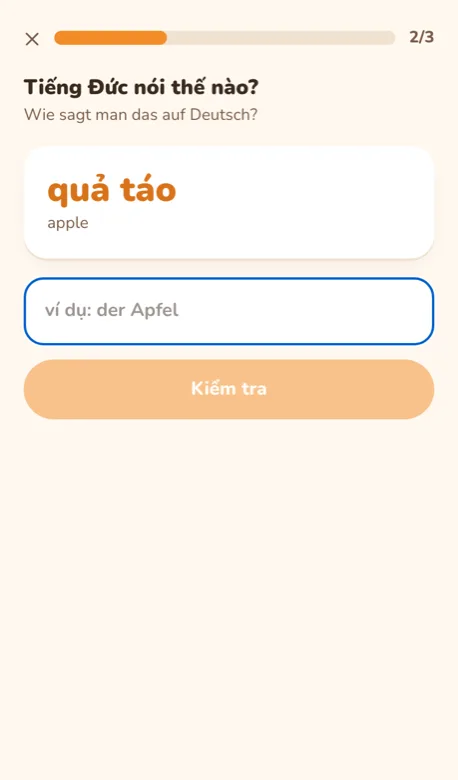
However, completing a sentence-building exercise is different from speaking fluently outside the app. Guided exercises and communication without prompts place different demands on you. We would use Fritz to strengthen vocabulary, then read aloud and create new sentences to check whether that knowledge transfers to communication.
Spaced repetition depends on returning to study
Fritz says it schedules reviews using the learner’s responses. The organizational advantage is that you do not have to choose every word to revisit each day. That description alone does not establish how accurately the schedule works or whether it outperforms another tool. Source: Fritz’s method overview.
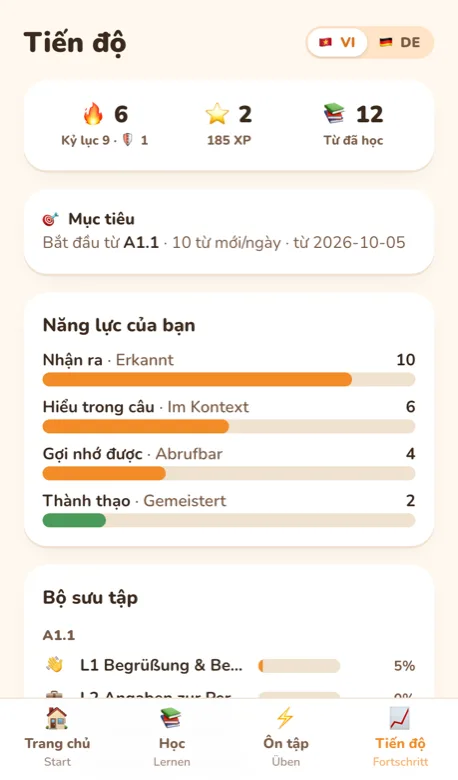
In practice, useful checks are whether the review workload feels manageable and whether frequently missed words return at helpful intervals. If you often miss sessions and reviews become overwhelming, adding fewer new words is a reasonable adjustment.
A suggested way to use the trial
The service terms advertise three days of free access to A1.1. That is enough to explore navigation and content, but not to establish long-term retention.
- Day one: choose a suitable topic, study a small set of words and read the phrases and examples carefully.
- Day two: complete reviews before adding new words; note which answers you could only guess.
- Day three: speak or write a few sentences outside the exercises, using the words without checking the answers.
You could divide a roughly ten-minute session between reviewing old words, learning a small new set and making sentences. This is our suggested routine; adjust the pace to the difficulty and your available time.
Verdict: a promising bridge from recognition to use
We like Fritz’s emphasis on phrases and increasingly demanding recall. The buying decision should depend on whether the examples and review pace work for you, rather than the size of the word collection or your study streak.
For broader context, read our overall Fritz review. If the method suits you, our pricing review compares plans against the length of time you actually intend to study.
Check the current price and what is included on the official site.