Greenlight Publish Review: A clearer checklist before your KDP upload
A source-based look at Greenlight Publish's four publishing checks, disclosure guidance, privacy claims and limits for independent KDP authors.
Greenlight Publish has a useful premise: the last step before publishing a book should be an organised review, rather than a collection of browser tabs. It brings AI-disclosure guidance, trademark screening, originality signals and print-file checks into one report.
Our initial verdict is cautiously positive for authors who regularly juggle those checks. The appeal is the workflow, especially the ordered list of issues to fix. The unanswered question is how reliably it catches problems in real manuscripts.
Review basis: We reviewed the official product page, its published walkthrough descriptions, example screens and offer terms on October 12, 2026. We have not run a paid scan or independently measured accuracy or speed. This is an editorial assessment of the advertised product, rather than a hands-on test; we are withholding a numerical rating.
What Greenlight Publish does
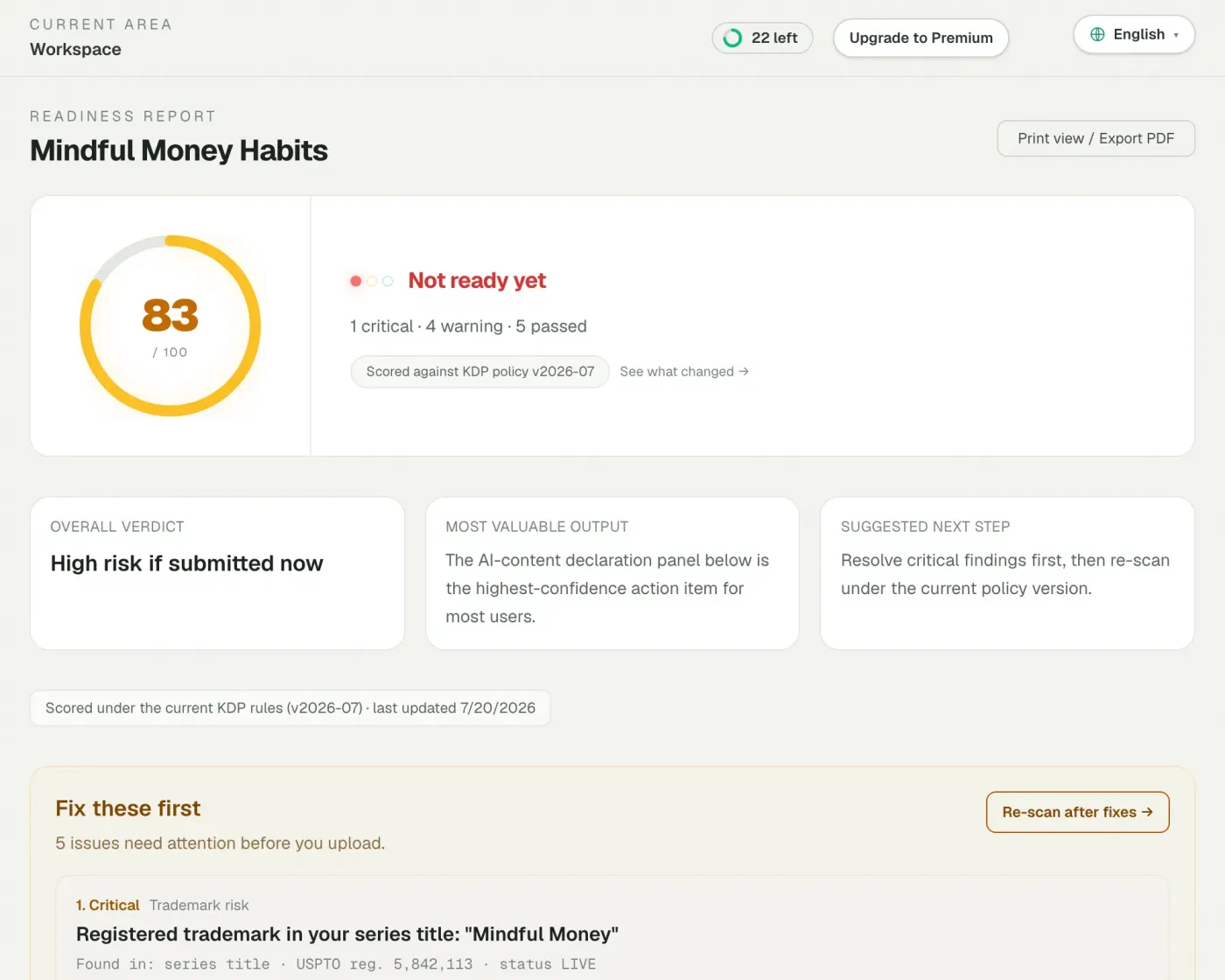
The published workflow starts with a manuscript upload and seven questions about how the text, images and translations were produced. The resulting report combines four checks and puts the most serious findings first. Greenlight also says each report records the KDP policy version used, with older reports flagged for another scan when that version changes.
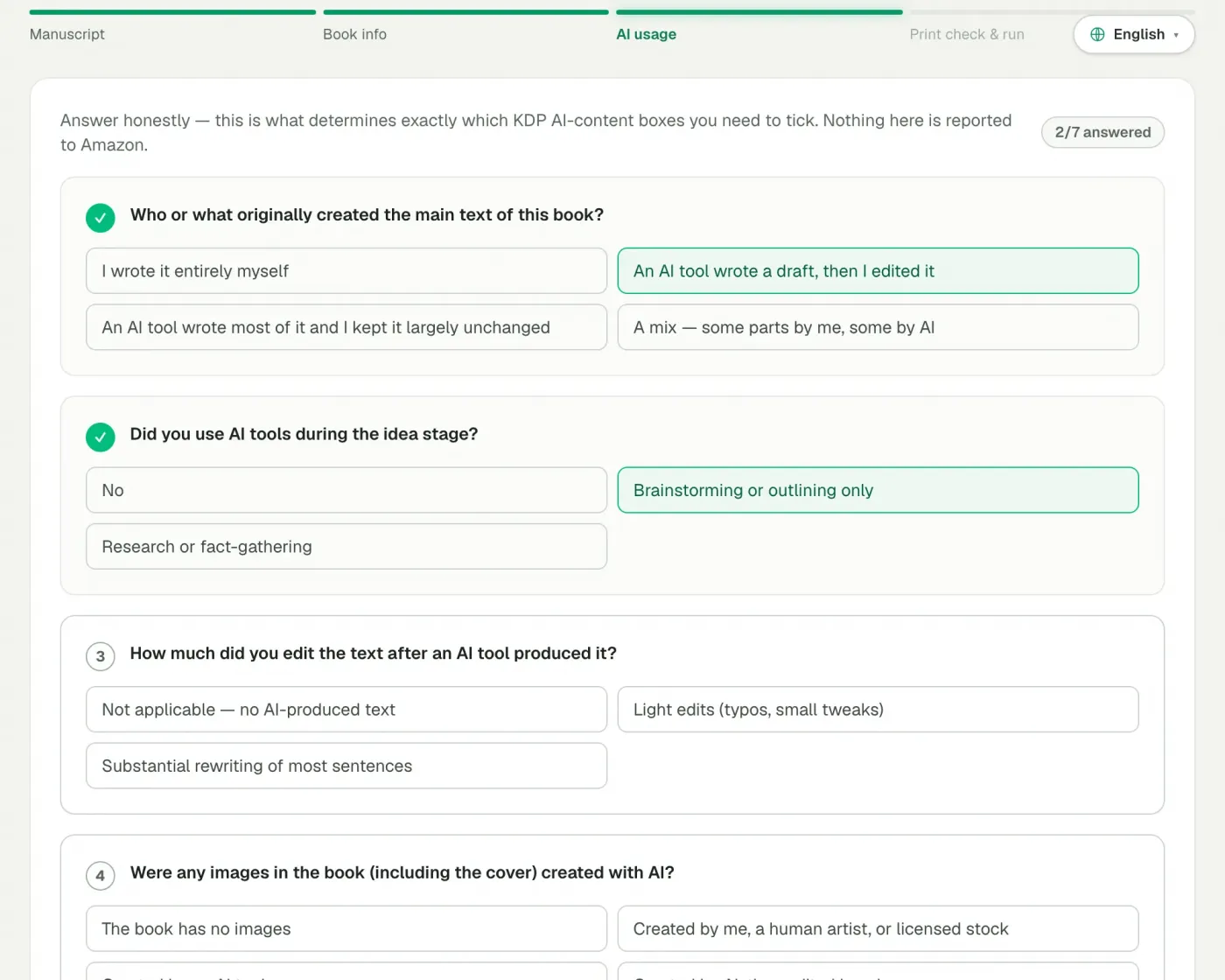
That structure is its strongest selling point. A publisher needs both the finding and the next action: which passage to inspect, which specification to adjust, or which production detail to review before answering Amazon’s disclosure question.
The four checks, assessed
AI-content disclosure
Greenlight describes a rule engine driven by the author’s answers, rather than an AI detector deciding how a book was written. That is a sensible design direction: a manuscript alone cannot establish the history of its creation.
There is an important distinction in Amazon’s own rules. KDP requires disclosure of AI-generated text, images and translations, while AI-assisted content does not require disclosure. The publisher still has responsibility for compliance. Check the official KDP content guidelines alongside any tool recommendation.
The practical limitation is input quality. If an author misdescribes the workflow, a consistently applied rule can still produce unsuitable guidance.
Trademark screening
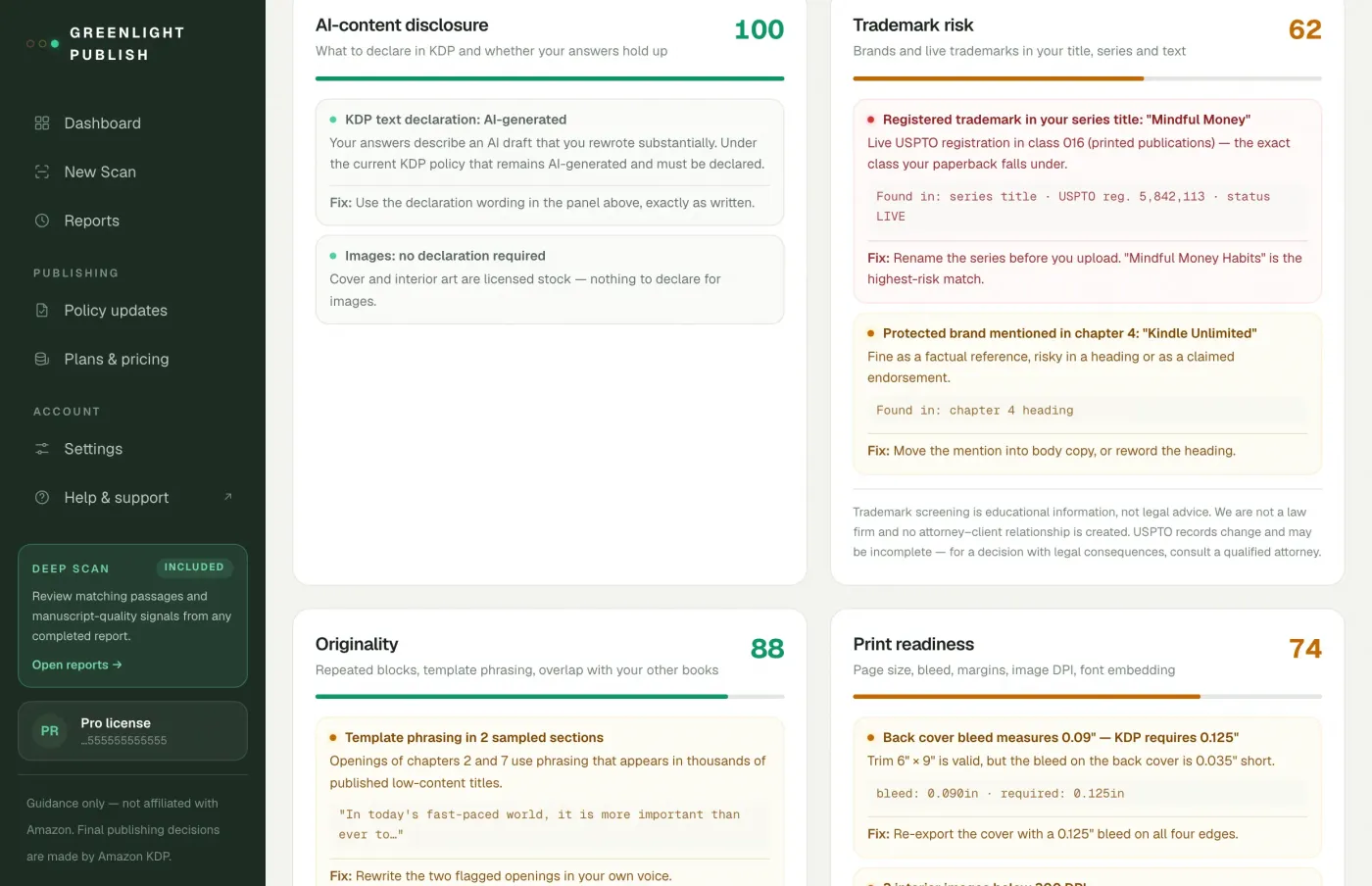
The product page promises title and series screening against live USPTO records, with registration details and classes shown. Evidence is more useful than an unexplained warning, because it gives the author something concrete to investigate.
This is a preliminary screen. Greenlight itself acknowledges third-party data limitations and does not provide legal clearance. A low-risk result should not be read as permission to use a name in every market.
Originality signals
The advertised core checks highlight repeated blocks, template-like wording and overlap with the user’s previously scanned books. That could help authors notice recycled material across a growing catalogue.
The current Starter feature list does not clearly establish a comprehensive web-wide plagiarism search. Ask the vendor about that scope if external source matching is your main reason for buying. A useful internal-overlap check and a broad external plagiarism search serve different purposes.
Print readiness
Greenlight says its PDF checks cover dimensions, bleed, page count, image resolution and embedded fonts, plus sampled margin checks and gutter guidance. For planners and workbooks, this may be the most concrete part of the offer.
Sampling matters: checking selected pages is not the same as inspecting every page. We cover that distinction in our review for low-content publishers.
Privacy: browser parsing still involves a server
According to the vendor, DOCX, PDF, EPUB and plain-text files are parsed in the browser, and the original manuscript file is not stored on its servers. Extracted text is still sent for scoring. The vendor also says questionnaire answers are not reported to Amazon.
This should not be described as fully offline processing. For unpublished or client material, clarify extracted-text retention and any external processing before upload. We have not audited the data flow.
Who is likely to benefit?
- Independent authors who publish often enough to repeat the same pre-upload checks.
- AI-assisted creators who want a structured record of how each part of a book was made.
- Planner and workbook publishers who need an extra review of exported interiors.
Occasional publishers with a reliable manual checklist may find the free official resources sufficient. Authors seeking editing, book design, keyword research or marketing will need other tools: these are outside the advertised readiness workflow.
Strengths and reservations
The strengths on paper are a focused four-check workflow, visible evidence, an ordered fix list and policy-versioned reports. Those features could make final review easier to repeat across several books.
Our reservations are the lack of independent accuracy testing, sampled margin coverage, unclear external-originality scope and the service dependency behind the one-time payment. The advertised two-minute scan is a vendor estimate, not a timing result from us.
Verdict
Greenlight Publish is worth considering as an additional pre-upload review for regular KDP publishers. Its best argument is a clearer sequence of decisions, not a promise of approval. A high score cannot guarantee Amazon will accept or keep a book live, and the product page explicitly says so.
Before buying, read our pricing and limits review and compare the current official offer with your publishing workload. After scanning, keep using your own editorial review and Amazon’s preview tools before submitting.
Check the current price and what is included on the official site.